Did Jesus Die for Those Without Sin?

Did Jesus only have compassion on saints and ‘good’ Christians? Or was his compassion on sinners? Was his ministry only to those who had never been saved? Did he only minister to those who lived “right?” Did the people in the Bible live a life committed fully to God, always? Rahab, Tamar, David, Bathsheba, Solomon, Saul-Paul, Zaccheus, the Kings, tax collectors, prostitutes, harlots, thiefs, murderers, (to name a few}? Who are the ones who need Jesus, the sinners and the ones not living for him, or the ones fully committed to Him? That’s a trick question, because the answer is all. We all need Jesus. 

But I’ve noticed many times that “churches & Christians” only accept a few sinners and other “Christians” based on conditions or legalities. Many times, these same churches hold their ministers up to a different standard than that of other Christians, but Matthew 23 has a good teaching on this, in that we only have one Father – God and one teacher – the Messiah. It is when we put ministers on pedestals and they accept that worship instead of turning it over to God, that they face the greatest danger of falling off the pedestal or throne. 

  

There are times that we, as Christians, have certain expectations for those who attend church, our fellow members, whether they are grounded in faith or not, we think that those who are converted are suddenly supposed to be without sin. Although in some cases, God does work in a very quick way to rid a person of most of the sins in their lives, it is usually a slow progression that the Holy Spirit convicts each individual of things in their lives that are not amenable to the life of a Christian. We are not instantly ‘set apart’ but it is a progressive salvation. We are gently and constantly reproved by the HOLY SPIRIT, NOT BY MAN. Sure there are times that a minister must point out repeated blatant sins that might be offensive or lead others astray; instead of allowing someone to live in a state of sin, but it isn’t a list that can be handed to someone or a church’s bylaws or legalities that can set someone on the ‘straight and narrow’ path. It is gentle reproof and love. But it is usually the churches whose doctrine is steeped in legalism, traditions, rules, and regulations, that drive away the newly converted tender hearts of  Christians, back into a life of sin. If only, these churches allowed God to be God, the Father, who is able to nurture, love, give comfort and compassion, to gently reprove, through the Holy Spirit, without a litany of laws. Bedsides, Jesus REDEEMED us FROM the law. Man has reintroduced new laws, traditions, and religion over the years and has termed them the ‘correct way to live or THE religion to follow.’ Yet the correct way to live is guided by the Holy Spirit alone. 

Galatians 5:16 So I say, let the Holy Spirit guide your lives. Then you won’t be doing what your sinful nature craves.

1 Corinthians 2:15-16 Those who are spiritual can evaluate all things, but they themselves cannot be evaluated by others. For, “Who can know the LORD’s thoughts? Who knows enough to teach him?” But we understand these things, for we have the mind of Christ.

When we are saved, we are given the Holy Spirit to guide us into all truth. We are given the mind of Christ. We must renew our minds by reading the Bible and allowing the Holy Spirit to reveal truth to us and through those who are put in Spiritual authority in our lives, but we must choose them wisely. God is our ultimate authority and if the person we are following is not following God or the Word, we need to find someone who is. Jesus is our teacher through the Holy Spirit. May we all grow in the Word through Grace and fellowship, preferring others before ourselves. May we submit to God and allow the Holy Spirit to convict us of sin and when we are convicted; may we have the strength and desire to turn from it. May we love and accept each other in our individual walks where we are. When the Spirit leads, let those who are mature, help those who are not, in love, not condemnation, but by example. 

Prayer: I ask for you Father to touch all who read this to allow the Holy Spirit to be their ultimate inspiration and convictor. In Jesus name. Amen!

Grace

The majority of my friends and family members are Awesome and help to maintain my Faith in humanity. Then there are those few that stretch me. At times, they really tttrrrrry my pa-tience and offers of grace, or even desire to show grace! Jonathan, my husband, will sometimes say the latter are the ones who are there for our “perfecting,” meaning that they make our faith grow. And I think, ‘Gee, how much more does my faith need to e-x-p-a-n-d?!!’

He’s right though, because if they are irritating me by the things they do and/or say, it shows I have not reached my own maturity in Faith. If and hopefully when I’ve come to a point that their actions, which are intended to provoke, do not irritate, but bring forth a response of love and compassion, then I’m getting closer to the patterned son, who treated sinner and redeemed alike. What greater love did he show than to give up his life to those who mocked and scorned him? 

What love can face a person who figuratively speaking, spits in their face and turn that anger to repentance without one word? What kind of love can heal? What kind of love, when weary will still minister to those in need? What kind of love is not angered when a close friend doubts their existence and allows them to touch him so they believe he exists? It is love full of grace; it is Perfect Love. I’m not there, but Jesus IS. May I grow to be more like him and exhibit His Grace!


Saved by grace… what does that mean?

Grace (charis in the Greek) is a free gift; something given without expecting anything in return; an undeserved kindness; a favor given by God through Christ Jesus. The one who gives grace offers a kindness or a favor; their speech is pleasing and courteous. One who bestows grace is not hindered by another’s sin or triggered by another’s good works. They are motivated by the heart of Christ Jesus, manifested in and through them. Grace is actuated by joy and imparts joy.  Grace prompts its possessors to confer benefits to others. Grace sustains and aids the efforts of those who labor for the cause of Christ, assisting those who are devout followers to be strengthened in their troubles. Grace is the ability to love those who don’t love you, to lend to others and expect nothing in return, to do without being asked. The one who receives and accepts grace feels gratefulness, homage (honor and faithfulness towards the giver) and respect (esteem) to the giver.

Divine grace – ‘Status gratiae’ in Latin – is the spiritual condition of someone who is governed (held in check) by the Spirit. Salvation is a gift of divine grace; it is a heart changing reality. Divine grace is also a Corporate Expression of the gifts given by God. 1 Peter 4:10 “God has given each of you a gift from his great variety of spiritual gifts. Use them well to serve one another.”

Jesus is the epitome of grace; he knew how to answer every man, even as a child in the temple, his words were gracious. Luke 4:22 He lived out a life of grace to the very end of his human life. Grace and Truth come from Christ alone. Righteousness is declared by grace to us through Christ Jesus. Romans 3:24 Grace frees us from sin and the penalty of sin. Romans 6:14Sin is no longer your master, for you no longer live under the requirements of the law.  Instead, you live under the freedom of God’s grace.”

Grace is to be shared with others. When it is shared and received it brings glory to God. 2 Corinthians 4:15

There is victory in grace, even in the midst of trial because there is joy in the acceptance. Grace given is multiplied. Grace is the sufficiency of God in all that we face in our earthly life. Grace replaces the law. Galatians 5:1-4 Grace produces words seasoned with salt–put into fertile ground – healthy people, salt preserves & purifies. Grace produces wisdom. Malachi 2:7 & Colossians 4:6

Hebrews 12:28 Therefore, since we are receiving a kingdom which cannot be shaken, let us have grace by which we may serve God acceptably with reverence and godly fear. (NKJV) “Let us have grace” means let us continue to hold onto grace.

Grace Is inherited. 1 Peter 3:7 & 4:10 Grace can be multiplied through growth. We are encouraged to grow in grace. 2 Peter 1:2-8 The more grace we understand and walk in – the more we copy the pattern of Christ Jesus – the more grace we will be able to show and share with others.

Prayer: Father help me to grow in your grace and use the gifts you have placed within me to serve others. Help me to continue to hold fast to the grace you have shown me that I might grow in the knowledge of you and be able to share your grace with others. Thank you that your grace is Sufficient! In Jesus’ name – Amen

(Note: Words in blue are hyperlinks to some of the verses I based this study on, click on the words to be able to view them.)

The Place of Separation and Sustainment

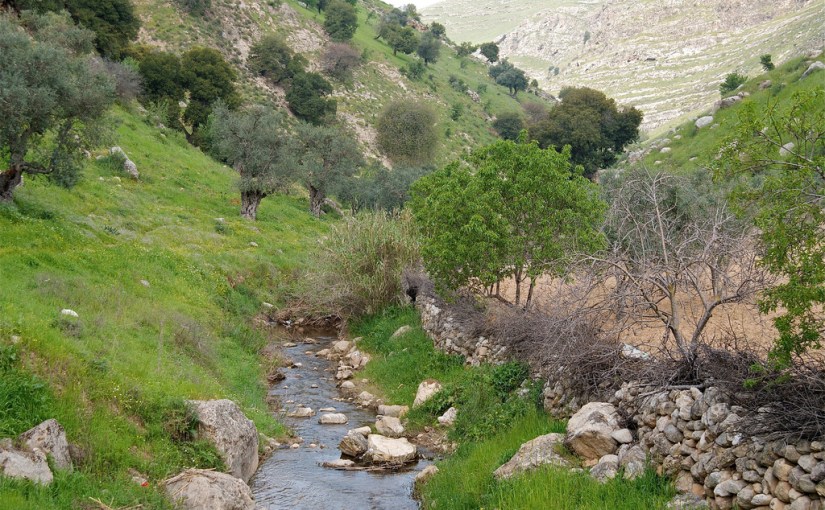
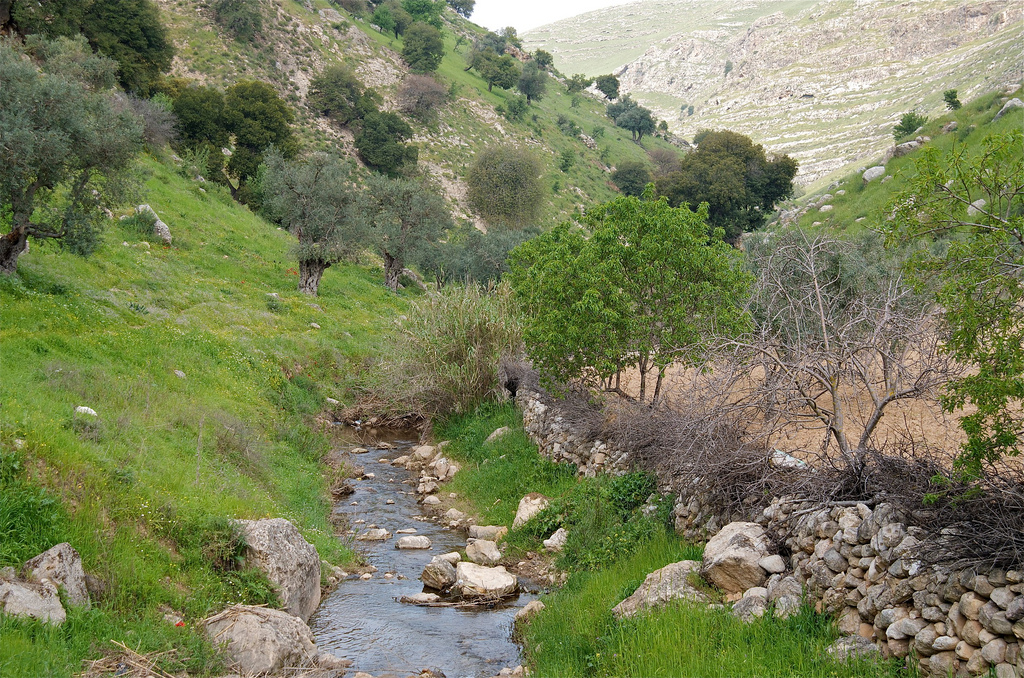
I shared on my Facebook page earlier this week about how God instructed Elijah, during a long drought, to go to the brook East of Jordan named Cherith. It is written in 1 Kings 17:1-7. In the Hebrew, the word Cherith, Chorath, or Kerith means “a place of separation.” If you locate where this brook is located, most modern scholars agree that it is the Wadi al-Yabis, a region that is described as one of the wildest ravines in the region. It is also so wild in terrain, that it is a place where one can easily hide from persecution and still be protected; it is a place of refuge. In this passage, God also told Elijah that he would send the ravens to bring bread and flesh to Elijah.

Cherith or Wadi al-Yabis by samdefranc

There are many things which need to be pointed out about Ravens. They are extremely intelligent, more than any other bird in the bird kingdom and rivaling that of the chimpanzee in the animal kingdom. They are adaptable to any habitat, mountainous, desert, rocky, grasslands, wetlands, etc., regardless of weather. Ravens can be taught to talk better than most parrots, imitating the human voice and the calls of other birds. They also communicate with each other with their beaks, such as pointing out an object to another raven. Another form of communication they use is to attract other animals to a carcass they want to feed on by their calls, because they cannot tear open with their beaks, then once other predators have opened the carcass for them, they can pick at the meat. They are not known to feed others, except their own babies. They are one of the dirtiest birds in the bird kingdom, yet they are survivors. They are scavengers, and are quite resourceful finding food by outwitting other birds and predators. They even follow the gunshots of hunters to locate a carcass to feed upon, yet ignore other equally loud sounds, showing signs of extreme intellect and recognition. They work in cooperation with each other to steal food, by distraction and/or observation. Ravens are playful and can play together, with other animals, or alone, solving intricate games and using comical behavior. They can fly upside down up to half a mile, do somersaults, and acrobatics. They are more agile than crows in flight, because they use light wingbeats and soar at times. During nesting times, they wash all their food in a nearby water source before feeding it to their nestlings. One of the facts I found to be most interesting is what a group of ravens are called, which is an ‘unkindness.’

"Corvus corax jouveniles". Licensed under CC BY-SA 3.0 via Commons - https://commons.wikimedia.org/wiki/File:Corvus_corax_jouveniles.jpeg#/media/File:Corvus_corax_jouveniles.jpeg
RAVENS – Licensed under CC BY-SA

Isn’t it just like God to take an unkindness and turn it into a kindness? And wouldn’t God choose one of the smartest, cleverest, most resourceful, and unlikely animals to provide for man who is created in his image? And wouldn’t God take an unlikely raven, who is greedy and selfish, to share of the food they find to sustain mankind? The ravens brought Elijah bread and flesh it tells us in First Kings. Don’t you imagine that those ravens took Elijah in as one of their own to do this? I even wonder if they washed the food before they gave it to him. As I was thinking of this, the ravens, a most common bird, were a substitute savior for Elijah. They took on some of the characteristics of Jesus, by taking care of God’s chosen, offering redemption from starvation in the form of bread and flesh. (Jesus is our bread and flesh. He took on the flesh of a man to dwell among us. He adopted us as his own, once we submitted to him. He is our sustainment and our redeemer.)

So when we find ourselves in a desperate situation that looks like we cannot go on, or have suffered an unkindness; we must remember Elijah and how God provided for him and then look to Jesus and remember that he is our ultimate sustainment, place of refuge, and redeemer. God will provide us a place of refuge, the brook of flowing water, and sustainment, but first we must separate ourselves from the worldly things that ensnare us and keep us from Him. We must put aside encumbrances to allow God to clothe us, to feed us, to supply all our needs, and to care for us better than we can ever care for ourselves. He may take us into a ravenous situation (a place of greedy hunger) to get our attention, or into a hidden wilderness where only he can provide to remind us that he is our sustainer and has provided our ultimate redemption in Jesus Christ. What hunger do you have that the world cannot satisfy? Where is your brook of separation? Have you found it, do you need to go there to renew your heart with God or simply to be sustained and cared for? It is with Jesus. Allow him to be your place of separation and sustainment today and every day.

Consider the ravens, for they neither sow nor reap, which have neither storehouse nor barn; and God feeds them. Of how much more value are you than the birds? – Luke 12:24

Interesting side note on the word raven-ous: The verb to RAVEN means to devour greedily, to seize, and to prowl hungrily. The adjective RAVENOUS is traced to Old French ravener, meaning ‘to seize,’ regarding water, meaning ‘swift flowing.’ Overall meaning: “voracious, greedily hungry, and seized.”

Prayer: May God seize us to have a voracious hunger and thirst for Jesus, as our sole sustainer, refuge, bread, and flesh.