Is There a Seat for Jesus?

Recently, I spoke with a friend who, upon moving to a new town, visited the local church she had grown up in. She said all the heads turned when she walked in, and they weren’t just looks of curiosity. As she found a seat, she had a feeling that she was sitting in someone else’s seat. She sat through the service, feeling uncomfortable. She continued to try to visit the church, picking different pews and different spaces within them for several Sundays. Each Sunday, she was met with the same reaction, that she was occupying a seat that belonged to someone else or that she was unwelcome. She even waited one Sunday until the last minute, after the church bells rang, giving everyone a chance to sit in their regular places. She still was met with turned heads and eyes looking down their noses. The minister never payed her a visit and she finally quit going. Why go where you don’t feel accepted or wanted? I’ve thought about our conversation a few times since and it strikes me how their reception is so unlike my friend’s personality. She embodies the same opening arms towards others as Jesus, not judging, but loving people exactly as they are. Others from all walks of life are welcome in her world.
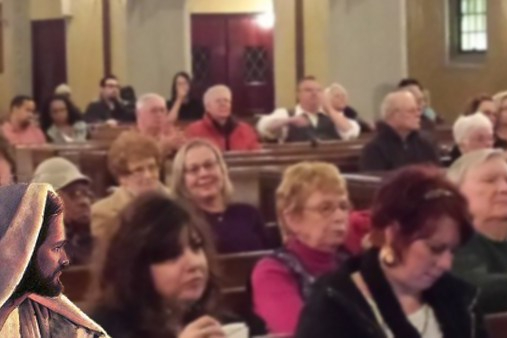
Jesus in church

I wonder what those church people could have had in their minds to be so cold to such a warm and caring person? Were there rumors or gossip they had spread and believed, which are usually lies? Or did they feel they were too good for her? Or were they so cliquish, that they didn’t accept others who hadn’t been in their fold for years? Greater still, would they recognize Jesus if he came through their doors and sat in one of the pews or would he have been met with the same huffs and looks of derision? I can tell you they did encounter Jesus, and they didn’t recognize him, because we carry Jesus with us, when we are believers. (Galatians 2:20 “My old self has been crucified with Christ. It is no longer I who live, but Christ lives in me. So I live in this earthly body by trusting in the Son of God, who loved me and gave himself for me.“) We are the light and perhaps that is what they didn’t like. Her light was dispelling their darkness and their sins of piety and holier-than-thou attitude.

I think of how opposite their attitude was to Jesus’ attitude towards others. The first one that comes to mind is the Samaritan woman. He hadn’t heard rumors about her, he Knew her life story, but that didn’t keep him from talking with her and offering her the living water. 

John 4:7, 9-10, 13-15 When a Samaritan woman came to draw water, Jesus said to her, “Will you give me a drink? The Samaritan woman said to him, “You are a Jew and I am a Samaritan woman. How can you ask me for a drink?” (For Jews do not associate with Samaritans.) Jesus answered her, “If you knew the gift of God and who it is that asks you for a drink, you would have asked him and he would have given you living water.” Jesus answered, “Everyone who drinks this water will be thirsty again, but whoever drinks the water I give them will never thirst. Indeed, the water I give them will become in them a spring of water welling up to eternal life.” The woman said to him, “Sir, give me this water so that I won’t get thirsty and have to keep coming here to draw water.”

He went on to ask her to call her husband and she said she didn’t have one and he told her she was right, she’d had five. But that didn’t stop Jesus from conversing with her or offering her salvation, because he didn’t look at her sins or what people said about her, he looked at her as redeemed. 

Another story that comes to mind is when Jesus ate with Levi, a tax collector and sinners. It was then that the pious teachers of the law had a fit! They couldn’t figure out why Jesus would eat with tax collectors and sinners. But how would he reach them, if he didn’t fellowship with them? They welcomed Jesus at their table and many turned their lives to follow him. 

Mark 2: 15-17 While Jesus was having dinner at Levi’s house, many tax collectors and sinners were eating with him and his disciples, for there were many who followed him. When the teachers of the law who were Pharisees saw him eating with the sinners and tax collectors, they asked his disciples: “Why does he eat with tax collectors and sinners?” On hearing this, Jesus said to them, “It is not the healthy who need a doctor, but the sick. I have not come to call the righteous, but sinners.”

So these were people that were not accepted in the community, but what about those who were? What about the leaders, how did they treat Jesus when he dined with them?
Let’s look at one Sabbath at a prominent Pharisee’s house, (maybe a deacon or bishop in today’s standards). 

Luke 14:1-4, 7-11 One Sabbath, when Jesus went to eat in the house of a prominent Pharisee, he was being carefully watched. There in front of him was a man suffering from abnormal swelling of his body. Jesus asked the Pharisees and experts in the law,“Is it lawful to heal on the Sabbath or not?” But they remained silent. So taking hold of the man, he healed him and sent him on his way. When he noticed how the guests picked the places of honor at the table, he told them this parable: “When someone invites you to a wedding feast, do not take the place of honor, for a person more distinguished than you may have been invited. If so, the host who invited both of you will come and say to you, ‘Give this person your seat.’ Then, humiliated, you will have to take the least important place. But when you are invited, take the lowest place, so that when your host comes, he will say to you, ‘Friend, move up to a better place.’ Then you will be honored in the presence of all the other guests. For all those who exalt themselves will be humbled, and those who humble themselves will be exalted.”

Jesus didn’t allow the circumstances of those around him to stop him from doing what his father had sent him to do, to heal the sick and save the lost. He also didn’t miss an opportunity to teach them how ill-behaved they were in choosing their seats and jockeying for position. So, to me, my friend was in good company, because her lifestyle was the same as Jesus, going again and again where she wasn’t wanted and continuing to love those who are rejected by society as she had been. I wonder, is there a seat for others in your life? Is there a seat for Jesus? 


Dousing the Fires that Destroy

We would be in a better frame of mind to remember when someone sets out to attempt to destroy us or assassinate our character because of envy, jealousy, or “perceived” offense, that it is our opportunity to shine. We are the only ones who can actually destroy ourselves by our re-Action to their tactics. They are exposing themselves and their own vulnerability and character by their attacks. They will eventually cause others to look at them more carefully and see their faults, if we keep a positive outlook, by focusing on who Jesus says we are and not others.

Unfortunately, some live a life of attempting to attack those around them who don’t cater to their every whim. We must allow them to self-destruct, however painful it might be. Jealousy, envy, and name-calling are at the root of a very bitter person. These behaviors are antithetical to a life led by the Holy Spirit. When a life is led by Jesus, it is full of the fruits of the Spirit; which are love, joy, peace, patience, kindness, goodness, faithfulness, gentleness, and self-control. Gossip is the opposite of these and one of the most insidious, because it entraps people and entices people to participate.  There are different forms of gossip also, as explained here: Proverbs 6:16-19 The definition of gossip is idle talk or rumors about the personal affairs of others; hearsay, scandal, and usually gossip isn’t a firsthand account, although there are those who gather evidence to use against you, posing as friends. Psalm 41:6 Many will try to disguise gossip and think it’s innocent to tell of another’s ‘troubles’ in a caring manner, but it isn’t and some don’t stop at caring; they do it out of vindictiveness. Gossip is a wildfire that must be put out – Don’t give an ear to its licking flames, don’t listen! Stop those who want to tell you the latest about others. When we shut our ears; by not listening; we are stopping those who want to share a ‘Bless their heart’ story. We are throwing water on the flames. If all of us did this, there wouldn’t even be a cinder left to ignite the flames.

I am reminded of an incident when I was a child about nine years of age. I grew up on my grandparents’ 80 acre pecan farm, with plenty of room to roam, and I loved it. One crisp, clear, cool fall afternoon, I piled up leaves about 30 feet from the back of our house to make a fort, which I was able to stack a couple of feet high. It was high enough that I could hide behind the walls if I scrunched down. I had plenty of material of twigs and dead leaves. The leaves were damp, so they stacked well. I had an active imagination and I was the youngest of three, much younger than my two older brothers, who usually couldn’t be bothered with a little sister. This allowed me to make up stories and play alone. But after I built the fort, sitting there became a bit boring and I wanted more excitement! I started to pretend an enemy had crossed the moat (our ditch) and set my fort on fire! But even then it wasn’t enough; I wanted to make it realistic. I knew we had matches in the house, because we had a gas range, which my mother needed the matches to light. Although I was forbidden to play with matches, I snuck in the back door, through our utility room, which led to the kitchen and waited patiently for my opportunity. I snatched a few from the box while my mother wasn’t looking. I ran back out and lit one on our concrete cellar and tried to catch my ‘fort’ on fire, but it wouldn’t spark right away, so I kept trying. I was on my last match when my father stuck his head out the back door to tell me dinner was ready. Knowing I shouldn’t be playing with matches, I dropped the match and ran for the house, forgetting the match was lit.
lit match
About 15 minutes into dinner, my father said, “I smell smoke! I wonder who’s burning today?” as he looked at my mother, he asked if any of the other farms had gathered their brushfires yet, and she replied that she didn’t know. Our closest neighbor was a quarter mile away. Suddenly it dawned on me how I’d dropped the match, so I jumped up and peeked through the dining room drapes to look. Just as I was about to be scolded for getting up from the table, I yelled, in a panic stricken voice, “My fort’s on fire!!” and pulled open the drapes. Everyone jumped up from the table to see, and my father barked out orders on what to do to put out the fire. We had to keep from burning all the leaves on the 80 acres, and I stood frozen there staring, then burst into tears. The fire was spreading quickly, even though the leaves were wet. I wasn’t thinking about the farm, I was thinking about all the work I’d done in building that fort for hours. Finally, I went outside and watched — the hose from the front yard was now hooked up to the back spigot, and my fort was almost gone, as I stood watching in horror! Then, I realized I had started this pandemonium with one small careless match. I snapped out of my remorse as I heard my father yelling about the pecan orchard, because I helped my grandfather on the farm all the time and realized the bigger picture. It wasn’t about a fort, it was about an orchard! I pitched in and all five of us worked with water and gunny sacks to put out the fire. Obviously, I was in trouble with my parents for playing with matches and starting a fire, but thankfully, it had only spread about an acre. About the time we had it almost out, my grandparents drove up to see why smoke was coming from our house, because from their vantage point it looked like our house was on fire. I don’t remember what my punishment was, because I was in so much remorse with what could have happened that my parents must have decided I had learned my lesson. But they weren’t easy on chastisement, so I must have had to do or go without something. 

I can think of so many parallels between gossip, responsibility, and carelessness from this story. I had to sneak into the house to get the matches. I was doing something that I knew I wasn’t supposed to do, but I went ahead, and when I got caught, I didn’t confess, I dropped the tiny lit fire. In starting the fire, I could have destroyed a whole orchard, think how many lives are destroyed by gossip. Also, when the fire caused the smoke, it caused panic and alarm, even bringing my grandparents hightailing through the farm to come to our aid. But some people don’t think of all the consequences of their actions. If I had thought about that lit match, I don’t I would have dropped it, but maybe I would so I wouldn’t get caught. Do you know people who even in the midst of telling gossip in front of the person they’re talking about, will quickly tell the story quietly? Gossip doesn’t stop with telling stories, relating facts, because sometimes the facts you know shouldn’t be shared and become misconstrued. If you ever played the game “Rumors” as a child, where you whisper a sentence in the ear of the person next to you and then it’s repeated and whispered through the ears of even just ten people, by that time it’s a completely different sentence. With gossip, the story is usually embellished, and every person has to add his or her own perception, that’s when the fire starts. Once the fire starts, it’s hard to put out, even if there are wet leaves (those who won’t listen) because there are a few dry leaves (those who will listen), so eventually you get a spark and then a smolder. Sometimes it takes a while for the smolder to linger, before the fire rages, like my fort fire. Then there’s damage and everyone comes running to put out what just one person started by being disobedient. This is why we must control our mouths and control our perceptions, we should never make presumptions or speculate. We cannot read other people’s minds or feel their feelings, those are theirs alone. It is best to contain a fire, by never allowing it to ignite. We should mind our own business and contain the fires. We should stop the fires that others want to start. 

People who shrug off deliberate deceptions,  saying, “I didn’t mean it, I was only joking,” Are worse than careless campers who walk away from smoldering campfires. When you run out of wood, the fire goes out;  when the gossip ends, the quarrel dies down. – Proverbs 26:18-20

A bit in the mouth of a horse controls the whole horse. A small rudder on a huge ship in the hands of a skilled captain sets a course in the face of the strongest winds. A word out of your mouth may seem of no account, but it can accomplish nearly anything—or destroy it! It only takes a spark, remember, to set off a forest fire. A careless or wrongly placed word out of your mouth can do that. By our speech we can ruin the world, turn harmony to chaos, throw mud on a reputation, send the whole world up in smoke and go up in smoke with it, smoke right from the pit of hell. – James 3:5-6


How do You Define Family?

Family is a unit of people who support each other. God created family for relationship with himself and with each other. Family synonyms: inheritance, relationship, people. Family is a group of people affiliated either by birth, by marriage, or by sharing, nurturing, accepting, and respecting each other. There are clear guidelines to what God doesn’t want in a family and what he does. Starting with the positive verses first and then the behaviors we should avoid. If we follow what God intended, it would encompass those who work together as one unit. By God’s definition, as a church or family, we are one body and in marriage, we become one person. The Bible tells us we each have a role to play:

The human body has many parts, but the many parts make up one whole body. So it is with the body [family] of Christ. Some of us are Jews, some are Gentiles, some are slaves, and some are free. But we have all been baptized into one body by one Spirit, and we all share the same Spirit… Love is patient and kind. Love is not jealous or boastful or proud or rude. It does not demand its own way. It is not irritable, and it keeps no record of being wronged. It does not rejoice about injustice but rejoices whenever the truth wins out. Love never gives up, never loses faith, is always hopeful, and endures through every circumstance. 1 Corinthians 12:12-13 & 13:4-7

“‘For this reason a man shall leave his father and mother and be joined to his wife, and the two shall become one flesh’; so then they are no longer two, but one* flesh. Therefore what God has joined together, let not man separate.” Mark 10:7-9

family

We are also told there are things that God detests in any family:

There are six things the Lord hates—no, seven things he detests:
haughty eyes,
a lying tongue,
hands that kill the innocent,
a heart that plots evil,
feet that race to do wrong,
a false witness who pours out lies,
a person who sows discord in a family. Proverbs 6:16-19

But to focus on individual families, such as parents, whose kids grow up and marry, eventually having kids of their own, then become grandparents… Where does God tell us to stand in this role? We’ve raised them the best we could, now it’s their turn. Do we continue to give advice? ‘No, not unless they ask, and then as led by the Holy Spirit. IF we put in our two cents, we must remember that it is only two cents, compared to their 98 cents – meaning they must make their own decisions!” We need to greet their decisions with open minds, not interference. The only exception would be, if they’re in a dangerous situation. Other than that, we should be hands off! We should embrace their spouse and make them feel comfortable and part of ‘the family’ — never an outsider. I call my children’s spouses ‘in-loves’ because their relationship goes deeper than a law or sheet of paper they signed. It is a commitment they’ve made; with God. This is where the peeling away of resistance comes into play. We must accept their decision, even if and when we don’t agree. Fortunately, I agree with my kid’s decisions in mates.

God spoke in the Old Testament of being circumcised to be part of his family. Under the New Testament or Grace, this would be circumcision of the heart, the peeling away of the layers of our heart that have hardened to anyone we didn’t choose for our kids; being open to those outside the family, by accepting them for who they are, not who we want them to be. Families accept not just their blood family, but also their children’s spouses. They don’t interfere by trying to influence their children against their partners by pointing out perceived flaws. 

For you are not a true Jew just because you were born of Jewish parents or because you have gone through the ceremony of circumcision. No, a true Jew is one whose heart is right with God. And true circumcision is not merely obeying the letter of the law; rather, it is a change of heart produced by the Spirit. And a person with a changed heart seeks praise from God, not from people. Romans 2:28-29 & Ephesians 2:11

As Jesus was speaking to the crowd, his mother and brothers stood outside, asking to speak to him. Someone told Jesus, “Your mother and your brothers are standing outside, and they want to speak to you.” Jesus asked, “Who is my mother? Who are my brothers?” Then he pointed to his disciples and said, “Look, these are my mother and brothers. Anyone who does the will of my Father in heaven is my brother and sister and mother!” Matthew 12:46-50

In the second verse, Jesus turned the verse around to those questioning him and said anyone who did the will of God is his family. Therefore by his view, there wasn’t anyone outside his family unless they didn’t follow God. So, how do we view “outsiders” in our family? Do we view them as those who follow God as being in our family or are they outsiders if they aren’t born into our family? Do we accept others or view them as foreigners? If they have children from a previous marriage, are their children truly part of the family or do we label them as ‘the former spouse’s kids?’ Do we treat them equally as our grandkids or do we give the “natural” grandkids preferential treatment? It doesn’t matter how they came into the family, and neither should the current spouse of our children, they should be embraced and accepted, just as we accept our OWN children, without preferential treatment and without prejudice.

Are we willing to accept our children’s decisions in choosing a spouse? Or do we think we know better than they; who is suited for them? If we don’t accept them, isn’t that a reflection on what we view as important? If we’re opposed to their decisions, perhaps our children have chosen someone diametrically opposed to our views and it’s alien to our thinking. Maybe our kids are tired of how we act and want to find someone with a different attitude. Perhaps it’s time to search our own souls instead of trying to find something wrong with their mate or find fault with our own children. Our opposition may require a little personal soul searching instead of attacks on their selection. Perhaps we should just embrace their decisions and keep peace in the family, instead of making their marriage difficult. 

How are we contributing to our own family? How are we contributing to our church family or the community family? Are we making a positive influence in each situation, or do we feel that if we make a positive influence at church, we don’t need to at home? The family influence starts in our homes. If we aren’t making a positive influence in our own home family, we aren’t effective at church family or in our own community. Have you met people who complain about their role at home, or all the volunteer work they do at church? It gets wearisome just listening to them. Jesus said take my yoke upon you, cease from our labors, and allow the Holy Spirit to work through us, at home, in church, and in the community. We need to submit to the leadership of God through Christ via the Holy Spirit. But the best way we can help our grown children is by staying out of their lives and accepting them. It is by not interfering. It is by setting good examples. The only example they or we should be following is the example of Christ. The only inheritance that matters is our inheritance of eternal life. When that is our focus and not what worldly goods we leave when we’re gone, or who we give preference to, then we’ll have peace in our families. But we must allow the Holy Spirit to guide us in our daily lives, each hour.

God has now revealed to us his mysterious will regarding Christ—which is to fulfill his own good plan. And this is the plan: At the right time he will bring everything together under the authority of Christ—everything in heaven and on earth. Furthermore, because we are united with Christ, we have received an inheritance from God, for he chose us in advance, and he makes everything work out according to his plan. God’s purpose was that we Jews who were the first to trust in Christ would bring praise and glory to God. And now you Gentiles have also heard the truth, the Good News that God saves you. And when you believed in Christ, he identified you as his own by giving you the Holy Spirit, whom he promised long ago. The Spirit is God’s guarantee that he will give us the inheritance he promised and that he has purchased us to be his own people [family]. He did this so we would praise and glorify him. Ephesians 1:9-14

We were chosen by God–the entire family of God, which is those who follow Him.


*Note: My emphasis in Mark 10